
One of the biggest barriers to moving natural asset / natural infrastructure planning and projects forward identified in the literature (e.g., Barrier identification framework for the implementation of blue and green infrastructures) and among practitioners is the lack of standards and guidelines. But perhaps it is not so much a “lack” as a failure to recognize and draw on the decades of research and applied work already done by Ecologists that continues to this day.
A good example of a well-established and widely accepted set of principles and standards for ecological projects developed over several years through consultation with many experienced professionals and their peers are the International principles and standards for the practice of ecological restoration (2019).
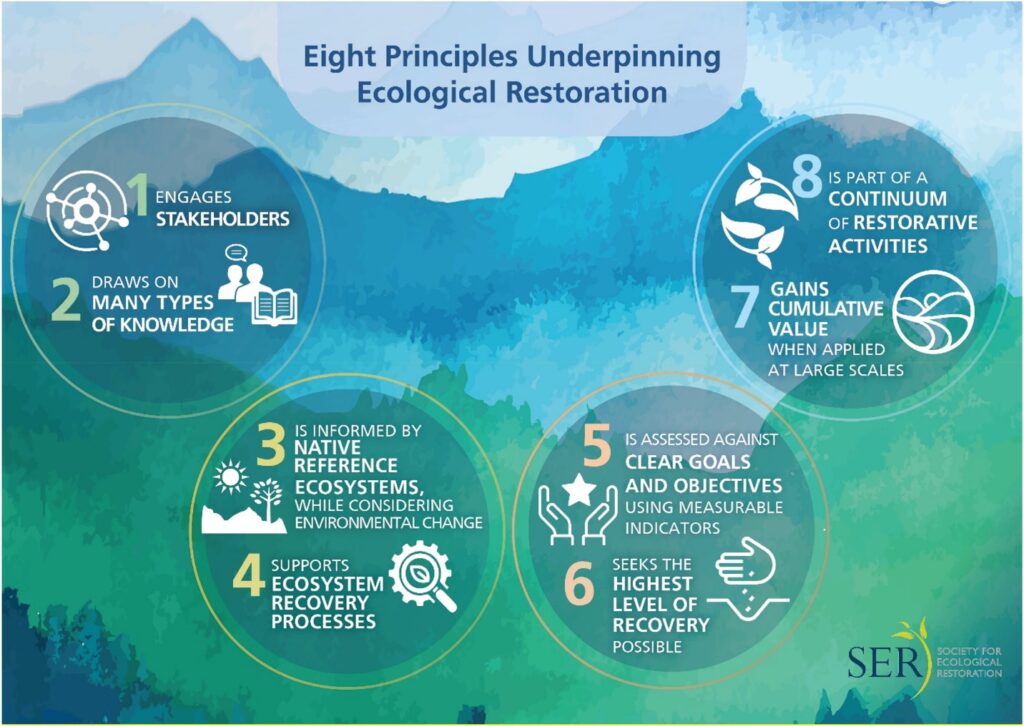
The eight principles that underpin ecological restoration outlined in this publication and illustrated in the graphic by the Society of Ecological Restoration are:
- Ecological restoration engages stakeholders.
- Ecological restoration draws on many types of knowledge.
- Ecological restoration practice is informed by native reference ecosystems, while considering environmental change.
- Ecological restoration supports ecosystem recovery processes.
- Ecosystem recovery is assessed against clear goals and objectives, using measurable indicators.
- Ecological restoration seeks the highest level of recovery attainable.
- Ecological restoration gains cumulative value when applied at large scales.
- Ecological restoration is part of a continuum of restorative activities.
These principles – and much of the guidance in this document – could (with a few language and contextual refinements) easily apply to natural asset / natural infrastructure creation / protection / management projects. This is equally true for other ecological classification systems and guidance documents that exist. We just need to connect the dots.